In the modern enterprise, we are drowning in data but starving for clarity. Most companies have invested millions into Business Intelligence (BI) tools, yet decision-makers still find themselves asking, "Why did this happen?" and "What do we do next?" only to be met with a shrug and a request for "two weeks to run the numbers."
At Bayeslab, we believe the era of passive dashboards is ending. We are entering the age of Deep Analysis.
But what exactly is Deep Analysis, and how does it differ from the BI reports we've been using for the last two decades? Let's dive in.
What is Deep Analysis?
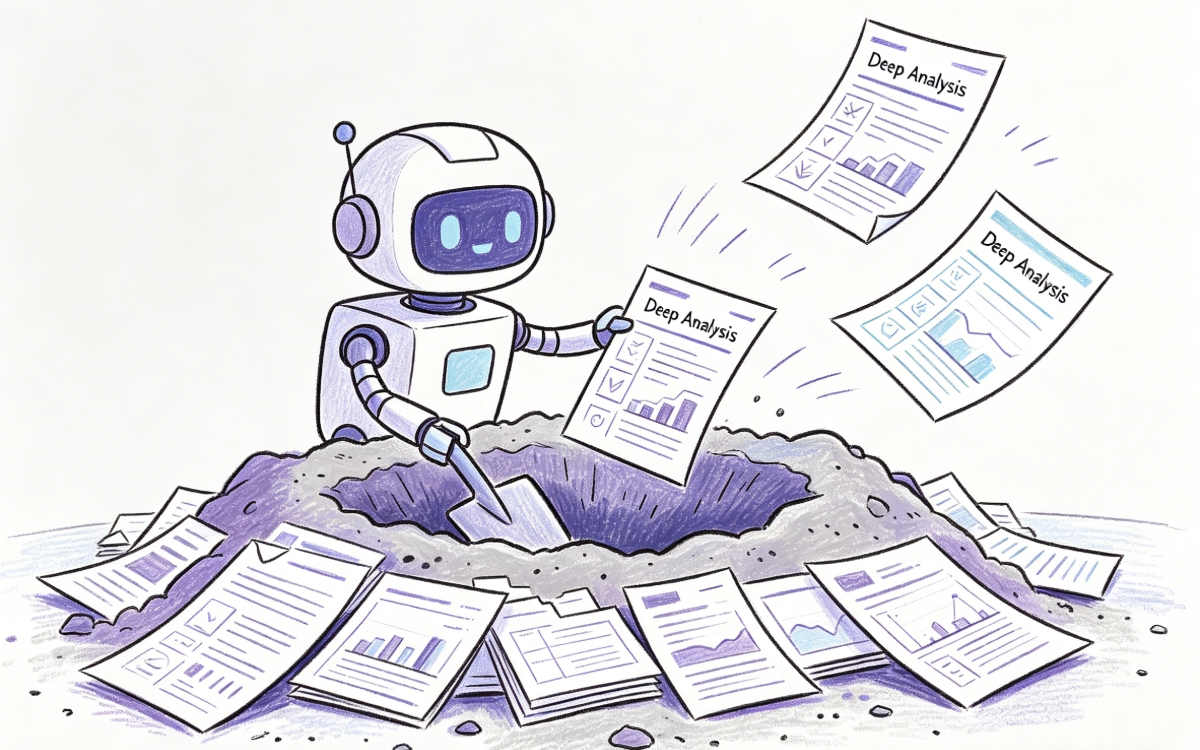
Deep Analysis is the process of examining data at its finest granularity to uncover hidden patterns, root causes, and actionable insights that summary statistics often miss.
Unlike traditional methods that rely on "averages" or "top-line metrics," Deep Analysis drills into the raw, multi-dimensional layers of information. It utilizes AI-driven, parallel, and multi-layered processes to analyze both structured (spreadsheets, SQL) and unstructured (customer feedback, logs) data.
Think of it this way: if traditional analysis is looking at a map of a forest, Deep Analysis is walking through the trees, checking the soil, and understanding the ecosystem of every individual sapling.
Core Components of the Deep Analysis Workflow
-
AI-Driven Orchestration: Modern deep analysis uses AI agents to break down a high-level business query (e.g., "Why did churn spike in EMEA?") into a dozen specific sub-questions, executing parallel analyses before synthesizing a final answer.
-
Zero-Loss Granularity: It bypasses the "mean" and the "median" to look at the outliers. In data science, averages often mask the very segment-level shifts that matter most.
-
Reproducible Logic: Every insight generated is backed by a verifiable chain of logic—code, statistical tests, and data lineage that you can audit.
-
Narrative Synthesis: It doesn't just give you a chart; it translates statistical findings into business language, providing "board-ready" reports and recommended actions.
Deep Analysis vs. Traditional BI: The Fundamental Shift
To understand why Deep Analysis is a "tectonic shift" in the industry, we have to look at the limitations of traditional Business Intelligence.
| Feature | Traditional BI | Deep Analysis |
|---|---|---|
| Primary Goal | Describing What happened. | Explaining Why and What next. |
| Data Handling | Pre-aggregated summaries & Cubes. | Raw, granular, and unstructured data. |
| User Effort | High manual effort (SQL, Pivot tables). | Agentic automation (Conversational). |
| Output | Static Dashboards & KPIs. | Narrative Reports & Actionable Insights. |
| Speed to Insight | Days or Weeks (The "Analyst Bottleneck"). | Minutes (Autonomous exploration). |
1. The "What" vs. The "Why"
Traditional BI is retrospective. It tells you your revenue was down 10% last month. That's a "What."
Deep Analysis starts where BI ends. It autonomously investigates the "Why"—identifying that the revenue drop was actually caused by a specific API latency issue affecting only Android users in the DACH region who joined after January. It moves from observation to diagnosis.
2. Static Dashboards vs. Fluid Exploration
Dashboards are rigid. They are built to answer the questions you knew you had six months ago. The moment a new, unexpected problem arises, the dashboard becomes useless. You have to go back to the data team and wait.
Deep Analysis is fluid. Because it is powered by AI agents, you can ask a question in plain English, and the system builds the "analysis path" on the fly, exploring dimensions you hadn't even considered.
3. The Gap Between Data and Decisions
The biggest failure of traditional BI is the "last mile." You get a chart, but you still have to spend three hours turning that chart into a PowerPoint slide with bullet points for your boss.
Deep Analysis treats the report as a first-class citizen. It bridges the gap by generating the narrative, the visualizations, and the strategic recommendations in one seamless flow.
Why Deep Analysis Matters for Your Team
Most teams today are stuck in the "Analyst Bottleneck." Decision-makers are waiting on analysts, and analysts are buried in "digital plumbing"—cleaning data and running the same SQL queries over and over.
Uncovering Hidden Value
Trends often hide segment-level shifts. A "stable" conversion rate might actually be a mix of one segment improving significantly while another is collapsing. Without Deep Analysis, you'd never know to intervene in the failing segment because the "average" looks fine.
Strategic Advantage
In a world where everyone has access to the same high-level data, the competitive advantage goes to the company that can find the "Why" faster. Whether it's detailed competitor intelligence, due diligence, or market-entry insights, deep analysis provides the "battle cards" needed to win.
Reproducibility and Trust
One of the biggest risks in ad-hoc manual analysis is human error. A single misspelled column name or a misinterpreted filter can lead to a multi-million dollar mistake. Deep Analysis agents minimize these errors by following reproducible, code-based workflows that are consistent every time.
Closing the Gap with Bayeslab
At Bayeslab, we didn't just build another data tool; we built a Deep Analysis Agent.
We saw the frustration of analysts at companies like Microsoft who were hired to be "thinkers" but spent 80% of their time as "data janitors." We built Bayeslab to reclaim that time.
Our platform doesn't just show you a dashboard. It takes your raw data, cleans it, performs multi-step root cause analysis, and generates a production-quality report—all within minutes.
The era of just "having" data is over. The era of truly understanding it has begun.
Ready to see what's hiding in your data?
Try Bayeslab for Free and experience the power of Agentic Deep Analysis today.